

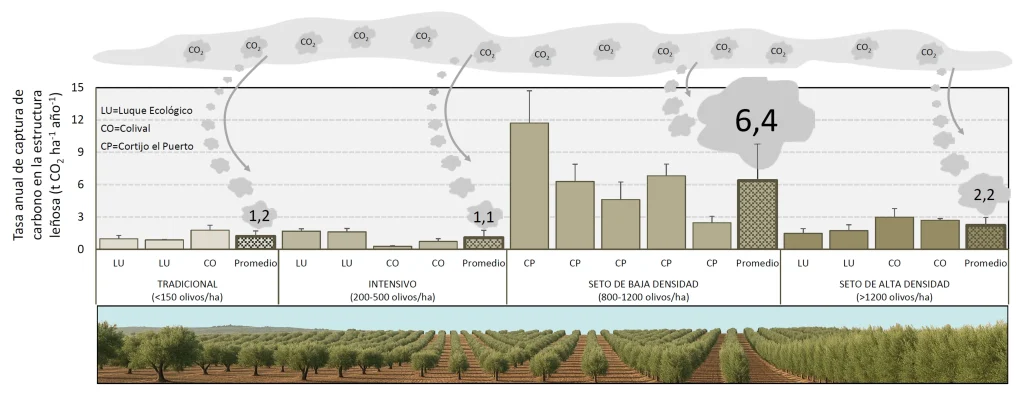
The first results of the GO OLIVE CARBON BALANCE Operational Group confirm that Andalusian olive groves act as an important carbon sink. In model farms such as Luque Ecológico, Cortijo El Puerto (Lora del Río) and Colival Valdepeñas, researchers have quantified the amount of CO₂ removed each year from the atmosphere and stored in the permanent biomass of olive trees (trunks, branches and roots).
The study, carried out by the Spanish Association of Olive-Growing Municipalities (AEMO), AgroecoliveLab and the Functional Unit of Ecology of INUO (University of Jaén), shows that all types of olive groves capture CO₂ effectively. The highest sequestration rates were observed in high-density hedge olive groves (>800 trees/ha), where values above 6 t CO₂ per hectare per year were recorded in some cases. Medium- and low-density olive groves showed sequestration rates ranging from 0.8 to 1.8 t CO₂/ha·year.
The amounts of CO₂ captured are similar to or even higher than the emissions associated with field operations, meaning that olive groves can be climate-neutral or even achieve a positive carbon balance, thereby contributing to climate change mitigation. Funded by AEI-Agri (PEPAC) under the framework of supra-regional agricultural innovation, the project reinforces the role of olive groves as a key green infrastructure in the fight against global warming.
More information:
https://olivecarbonbalance.ecovalia.org/captura-carbono-olivares-andaluces/