Applied agroecology group

Harvesting the future

News

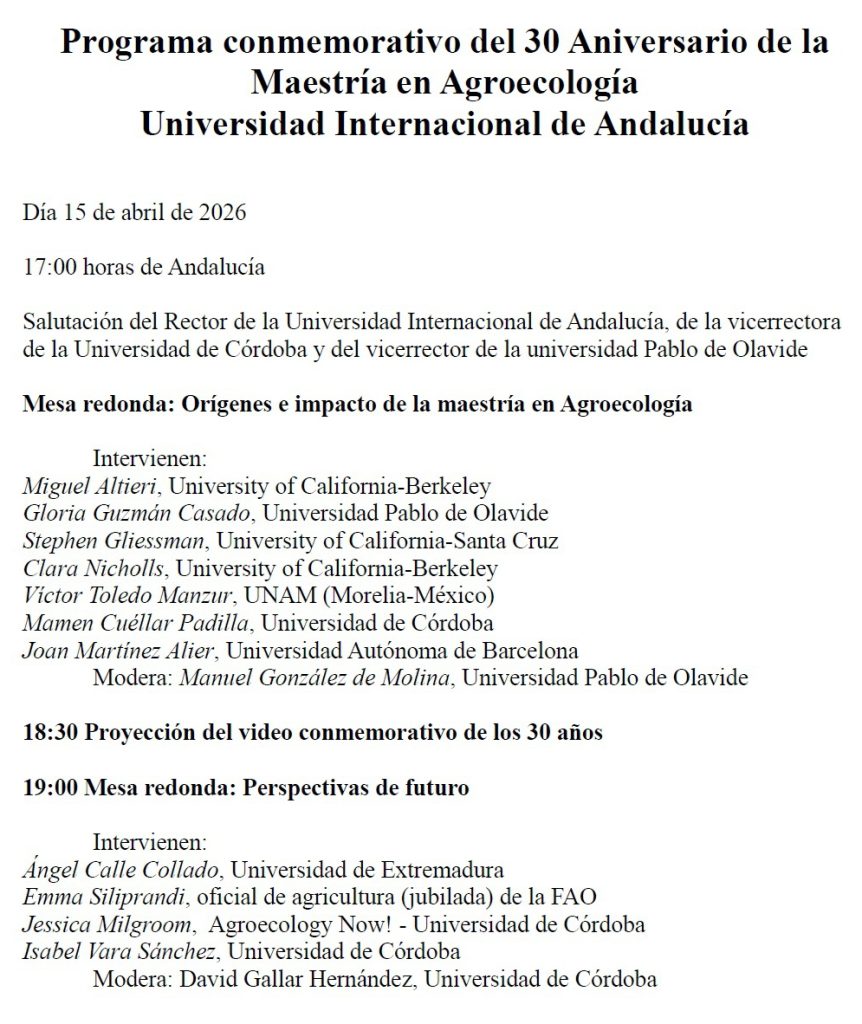
30th Anniversary of the Master’s Degree in Agroecology

The International University of Andalusia (UNIA) celebrates the 30th Anniversary of the Master’s Degree in Agroecology, an initiative that has spent three decades promoting the sustainable transformation of agri-food systems.

The event will take place on April 15, 2026, in Baeza (Jaén) and will feature the participation of leading international figures in the field of agroecology, as well as a live broadcast.

📌 Check the full programme in the attached image.

Organic Farming Improves Soil Health and Biodiversity

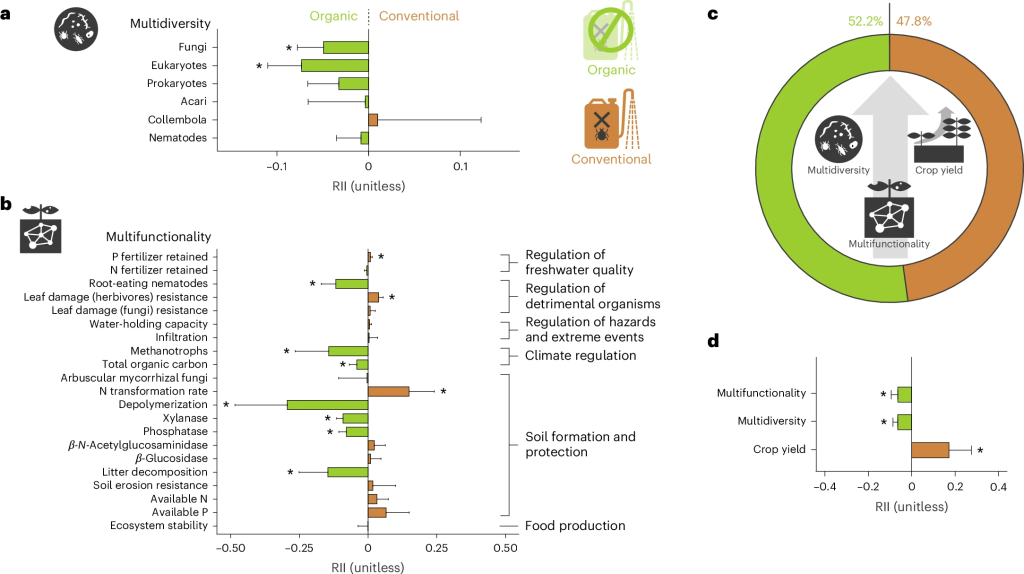
A new international study published in Nature Sustainability, led by Laura García-Velázquez, researcher from University of Alicante, and co-authored by Victoria Ochoa, researcher at AgroecoliveLab, shows that increasing the proportion of organic farming can contribute to healthier and more diverse soils.

The research analysed 179 agricultural landscapes with different shares of organic farming and found that areas with a higher presence of organic agriculture host richer and more diverse soil communities. These biological communities play a key role in maintaining soil functions such as nutrient cycling, soil structure and ecosystem resilience.

The results highlight the importance of promoting farming systems that enhance soil biodiversity and ecosystem services. Expanding organic farming within agricultural landscapes could therefore be an effective strategy to improve soil health and support more sustainable food production systems.

Mission Soil Manifesto

AgroecoliveLab has signed the Mission Soil Manifesto of the European Union, reinforcing its commitment to protecting and improving the health of agricultural soils, especially those of Andalusian olive groves. We invite all stakeholders involved in soil health to join this initiative and actively contribute to the mission:
https://mission-soil-platform.ec.europa.eu/

AgroecoliveLab Supports Vocational Education and Training

AgroecoliveLab considers Vocational Education and Training (VET) a practical and excellent pathway for preparing highly qualified professionals capable of responding to the labour market needs of the agri-food sector.

Within this framework, we have recently applied to the Erasmus+ KA220-VET call for cooperation projects in vocational education, together with partners from Portugal, Italy and Greece. The initiative aims to contribute to the modernisation of the European VET curriculum related to the olive grove and olive oil sector.

In line with this strategic commitment to vocational education, the AgroecoliveLab laboratory has welcomed three internship students this week from the Higher Vocational Training Programme in Clinical and Biomedical Laboratory at the CDP IFP Aventura (MEDAC) training centre.

Students Lourdes Montiel, María del Carmen Pérez and Ariana Zambrano will carry out their internship period in the laboratory facilities, where they will participate in various experimental support tasks and contribute to the team’s daily technical work.

The training placement is supervised by AgroecoliveLab researcher Victoria Ochoa, who will guide the students throughout their learning process in the laboratory environment.

Through initiatives like this, AgroecoliveLab aims to strengthen collaboration with vocational training centres and provide students with direct contact with real research and technical work environments, contributing to the training of the next generation of professionals in the sector.

Why Is Soil “Happier” When It Has Plants and Earthworms?

Researchers from AgroecoliveLab actively participated in the programme of the International Day of Women and Girls in Science, organised by the University of Jaén and held on February 17, 2026. The initiative included a wide range of workshops and science outreach activities aimed at students from different educational levels.

During the workshop “Why Is Soil ‘Happier’ When It Has Plants and Earthworms?”, we explained to students from CEIP San Marcos (Garciez) the importance of vegetation cover in protecting soil from erosion, improving its structure, and enhancing biodiversity. We also explored the fundamental role of earthworms — true soil engineers — in improving soil fertility and recycling nutrients through composting processes.

It was an enriching experience that demonstrates how fostering scientific curiosity from an early age is key to building a more sustainable future.

Agroecology master students visit an organic olive grove and mill in Jaén

Students from the Master’s Degree in Agroecology: A Sustainable Transformation Approach to Agri-Food Systems at the Universidad Internacional de Andalucía (UNIA) recently took part in a field visit aimed at strengthening their practical understanding of agroecological principles applied to olive production systems.

The visit was led by Roberto García, Principal Investigator of AgroecoliveLab and Professor at the University of Jaén, and included a tour of an organic olive grove located between Pegalajar and Mancha Real (Jaén), as well as a local olive oil mill. During the activity, students were able to engage directly with the farm owner and discuss key aspects such as nutrient inputs, energy flows and biodiversity-based management practices, including the use of livestock for weed control and soil fertilisation.

Participants were also introduced to the “Olivares Vivos” programme, an enhanced sustainability certification that integrates biodiversity conservation criteria alongside organic production standards. This hands-on experience allowed students to connect theoretical concepts — such as agroecosystem structure, nutrient cycling and ecological management — with real-world practices.

The field visit forms part of the master’s educational approach, which combines academic training with practical experiences to prepare future researchers and professionals committed to the development of sustainable agroecological systems.

When agricultural management makes the difference in the carbon balance

For years there has been debate over whether Mediterranean agriculture can shift from being part of the climate problem to becoming part of the solution. In this work, AgroecoliveLab explores to what extent olive grove management can sway the carbon balance one way or the other.

The study evaluated 16 olive farms in Andalusia by combining measurements of emissions and carbon accumulation in both soil and woody biomass to estimate the annual net carbon footprint at the farm scale.

Key results:

  • Farms with higher inputs of organic carbon showed clearly more favorable carbon balances, even behaving as net CO₂ sinks.
  • Carbon sequestration in soil and biomass can fully or partially offset the emissions associated with farm management.
  • Fuel consumption, nitrogen fertilisation and irrigation remain the main sources of emissions and therefore key points for action.

A central idea: The tree itself has a limited capacity to accumulate carbon; it is soil management that ultimately determines whether an olive grove acts as a sink or not. When poor soil management is combined with high intensities of fertilisation, irrigation and machinery use, the balance clearly shifts toward emissions. Identifying which management decisions truly matter is key to designing realistic, measurable and field-applicable carbon farming strategies.

You can now calculate the nutrient balance of your olive grove with the new NUTRIOLIVAR project tool!

The NUTRIOLIVAR project, developed by AgroecoliveLab and co-funded by FEDER, makes available to the public a free, easy-to-use calculator, available in English and Spanish, that allows users to estimate the nutrient balance in olive groves.

This tool has been designed to support farmers, technicians and land managers in understanding nutrient inputs and outputs within their olive groves, helping to improve fertilization management decisions and promote a more efficient use of resources.

The nutrient balance calculator contributes to a more sustainable and rational fertilization strategy, supporting olive productivity while reducing environmental impacts.Would you like to know whether fertilization in your olive grove is adjusted to its real needs?
Try the calculator and find out for yourself:

Click Here!