
Applied agroecology group

Harvesting the future

News

An Olive Grove in decline

The prestigious journal Nature Sustainability has recently published a highly relevant article confirming the significant decline that Andalusian olive groves are undergoing.

😔 In the words of the authors: The cultivation of steep, erosion-prone land, combined with the replacement of manure by chemical fertilizers and the widespread adoption of clean weeding, has reduced soil water retention and exacerbated

runoff, making production systems more vulnerable to droughts and extreme rainfall events.

➡️Full article here: https://www.nature.com/articles/s41893-025-01628-3

🫒 Thousands of olive growers are already working to reverse this situation. On our website, you can find some of the key steps to achieve it: https://agroecolivelab.com/en/home/

News on ClimateCropping project

Our team has actively contributed to the summer Newsletter of the ClimateCropping project, a project that aims to quantify, through the Life Cycle Assessment (LCA) methodology, the environmental impact of different crops from various European countries under different management practices, with a particular focus on comparing more sustainable practices with conventional ones.

Extra information here: Newsletter ClimateCropping

Regenerating the soil. The magic of cover crops

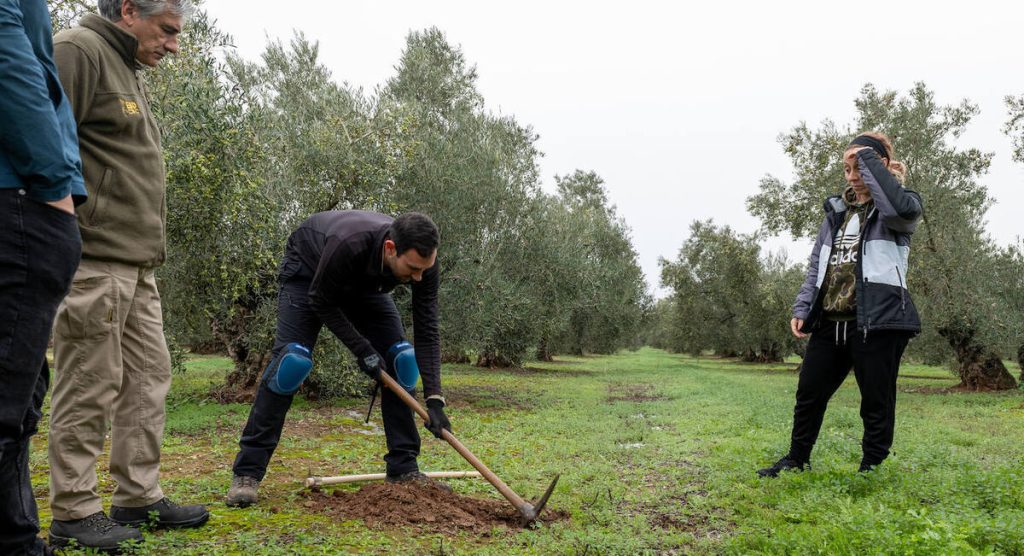
At the beginning of June, part of the AgroecoliveLab team held the workshop “Regenerating the soil. The magic of cover crops” for the 5th-grade students of CEIP Nuestra Señora de Zocueca (Bailén, Spain). This scientific outreach activity was part of the School of Science initiative, organized by the University of Jaén. During the workshop, the children learned why it is so important to protect the soil from erosion and how cover crops act as a key ally in this process. They also discovered the crucial role of soil organic matter and how earthworms help transform it into compost, a natural and effective way to enrich the soil and improve its fertility.

The Estepa PDO holds three seminars on how to reduce the carbon footprint in olive groves

Between June 3rd and 5th, our colleague José Liétor led a series of three participatory workshops on CO₂ credit certification mechanisms in the voluntary olive grove market, as part of the C-Olivar Project. The sessions were held at various cooperatives within the Estepa PDO, covering the Spanish municipalities of Puente Genil (Córdoba) and Estepa (Seville). In total, around 100 farmers learned first-hand about the growing carbon credit market applicable to the olive oil sector, as well as the management practices that can help them access this promising incentive. The workshop series received significant media coverage, including a radio interview on Cadena Ser.

Link to the news article (Spanish). Link to te radio interview (Spanish).

Estimation of potential income of the Estepa PDO

Our estimate of the potential income for the entire DOP Estepa (Sevilla, Spain) has been published, in the event of implementing a carbon farming project based on more sustainable management practices. These practices would increase the capacity of the olive groves to capture atmospheric CO₂, resulting in a greater contribution to climate change mitigation. Link (Spanish).

Good Practices Manual for Reducing the Carbon Footprint of Olive Groves

At the beginning of June, the DOP Estepa presented the “Good Practices Manual for Reducing the Carbon Footprint of Olive Groves”, developed by our colleague José Liétor. This tool, which was very well received by farmers, has become a key reference document for clarifying concepts that are often confused, such as sequestration, balance, footprint, and carbon credits.

Link to the Flipbook to read the full manual (Spanish).

Closing of the C-OLIVAR project

A golden finale for the C-OLIVAR project at the 30th Olive Grove Conference of ASAJA Sevilla. The assembly hall of Oleoestepa SCA. was filled to capacity to hear first-hand the results of the C-OLIVAR project — an initiative that has shown that olive groves not only produce oil of the highest quality but can also become a key tool in the fight against climate change and a source of future profitability for farmers. Our coordinator, Roberto García, captured the audience’s attention by presenting the valuable results obtained from the CO₂ credit certification simulations carried out during the project.

Participation in the Scientific Symposium of the Expoliva 2025 Fair

This year, the AgroecoliveLab team has been especially active at the Scientific Symposium of the Expoliva 2025 Fair, with several contributions in both oral and poster formats:

  1. Potential carbon sequestration capacity in olive grove soils through the addition of olive pomace compost and biochar.
  2. The contribution of traditional mountain olive groves to climate change adaptation.
  3. Effect of ground cover and soil organic carbon in olive groves on CO₂ capture.
  4. Olive grove capacity for CO₂ sequestration: management effects.

In addition, our coordinator, Roberto García, participated in one of the fair’s main events as a speaker on the panel “Keys to the environmental sustainability of olive-growing systems.”